
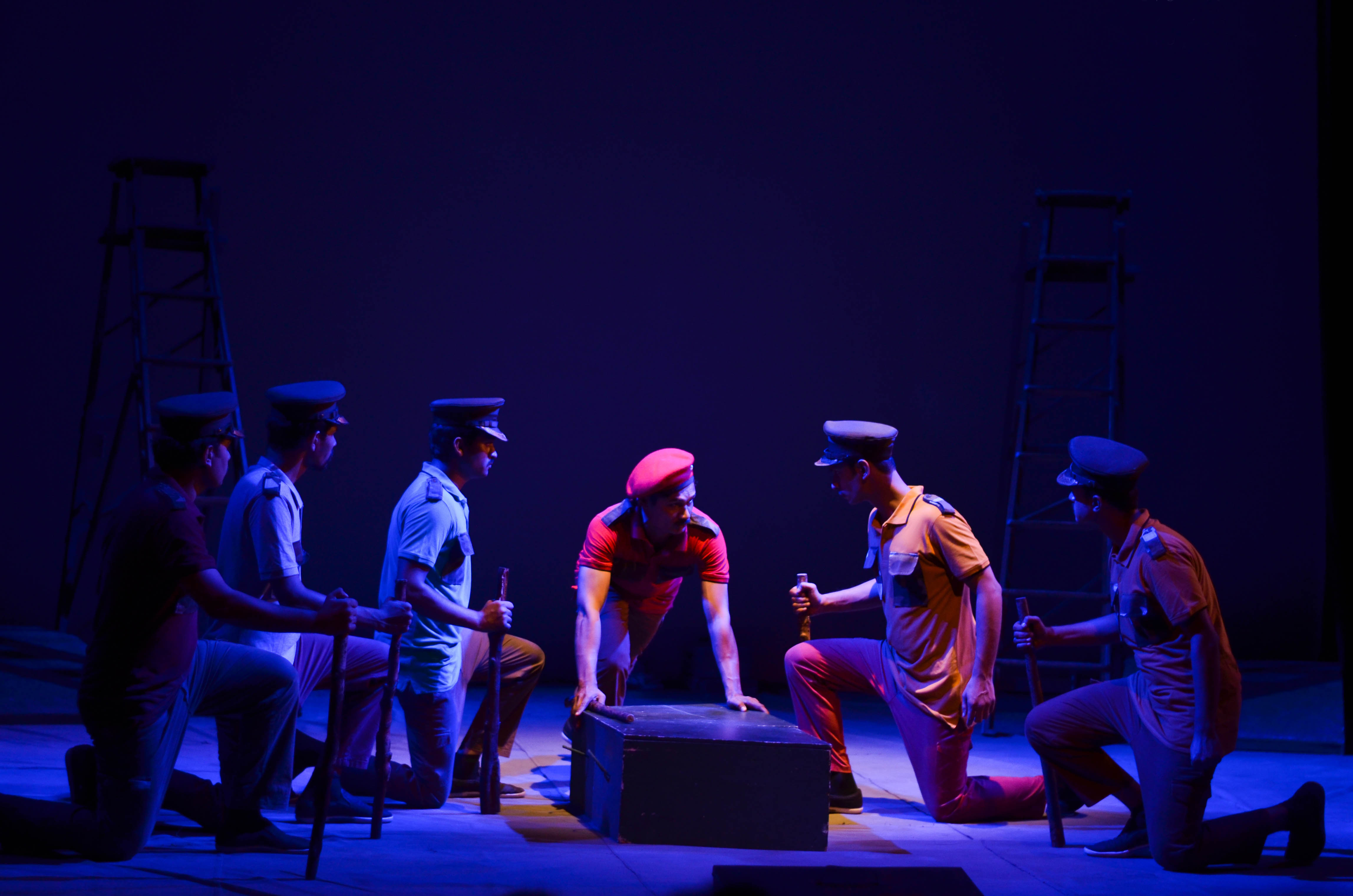
Crutch-er Colonel
Bottala Production – 9 Crutch-er Colonel (1 December 2016) Novel: Shahaduzzaman Adaptation: Soumya Sarker and Samina Luthfa Nitra Director: Mohammad Ali Haider
Storyline: The story begins in the rehearsal room of a theatre troupe. They are rehearsing a play based on the life of Colonel Taher. However, at the last moment, the lead actor refuses to perform the controversial role and is absent. This sparks a heated debate among the group about who will play the hero. As the rehearsal continues, their search for the protagonist unfolds through the act itself. They begin narrating the tale of Colonel Taher—a valiant warrior of history—recounting his courage, his love, and his refusal to bow his head before injustice. Based on the wide-ranging background of the novel Crutch-er Colonel by the eminent writer Shahaduzzaman, the play—directed by Mohammad Ali Haider of the theatre group Bottala—brings to the stage the affectionate family life of Colonel Taher, his escape from Pakistan, his return to join the Liberation War, the loss of his leg on the battlefield, his post-war vision of forming the ‘People’s Army,’ and his deep faith and affection toward Major Ziaur Rahman. Through the narrator’s voice, the play presents vivid depictions of crucial historical events and figures. In fragments of rehearsal scenes before the technical show, the audience witnesses the turbulent period from 1972 to 1975 and the subsequent political instability in Bangladesh—the formation of JASAD under Siraj Sikder’s leadership, Colonel Taher’s resignation from the army to enter politics, and the conspiracy of Khandaker Abdur Rashid and Khandaker Mushtaque Ahmed leading to the brutal assassination of Bangabandhu Sheikh Mujibur Rahman and his family. It further portrays Mushtaque’s assumption of power, Khaled Mosharraf’s coup, and the killing of the four national leaders in prison as Mushtaque’s final act of vengeance. The play also portrays Colonel Taher’s daring rescue of Major Ziaur Rahman from house arrest, and later, Zia’s betrayal and ingratitude that led to the unjust trial and execution of one of history’s great heroes—Colonel Taher. Amid the rehearsal setting, between different scenes, the performers engage in reflective discussions, analyzing and debating the various sides and implications of these historical events, presenting their own perspectives and reasoning.
Novelist’s Note: Crutch-er Colonel is a documentary-style novel based on the dramatic period surrounding Bangladesh’s Liberation War. Through the complex, controversial, and fascinating character of Colonel Taher, I have sought to understand that turbulent turning point in Bangladesh’s political history. During the 1960s and 1970s, as the world was divided into two camps—capitalist and socialist—countless young men and women across the Third World were inspired by the dream of creating an egalitarian, socialist society. Colonel Taher was a product of that generation. He joined the army as a strategic maneuver within a specific revolutionary ideology. Later, through a daring escape from a West Pakistani cantonment, he joined the Liberation War, where he lost a leg in a fierce operation. Leaning on crutches, he then led an extraordinary soldiers’ uprising and ultimately fell victim to one of the subcontinent’s most notorious political executions. In pursuit of an ideal, he gave as much as a person could possibly give—everything. Though he failed to realize that ideal, sometimes failure itself can shine brighter than conventional success, demanding our deepest attention. In the discourse of Bangladesh’s political history, Colonel Taher often remains hidden, neglected, or shrouded in conflicting narratives. As a writer and a curious observer of Bangladeshi politics, Crutch-er Colonel is the result of my literary confrontation with this exceptional figure. In a politically divided country, reconstructing the true historical account of Colonel Taher amidst layers of confusion was a formidable task. Through extensive research—studying documents and interviewing those connected to that era—I tried to grasp the flesh-and-blood journey of Abu Taher. I sought to explore how the son of a stationmaster, who grew up along the tracks of the Assam-Bengal Railway, could one day stand on the gallows and recite: “I was born to defeat death.” Colonel Taher was the lonely sacrifice of a dream-driven generation. Yet, I see him not merely through his success or failure, but through the depth of his aspirations. For the sake of our collective identity, we must reassess the visible and hidden figures that shaped our history, even the most debated ones. This novel is such an attempt. It is not just the story of one colonel, but of a people caught on the carousel of change, during a time steeped in both dream and delirium. When I wrote Crutch-er Colonel, I never imagined its stage potential. Given its vast historical scope and intricate political narrative, I believed it would be extremely difficult to translate into the language of theatre. While readers have the freedom of imagination, presenting this within a specific visual form on stage is a massive challenge for any director or actor. I am deeply impressed that the theatre group Bottala has dared to take up this challenge. I extend my heartfelt congratulations and best wishes to all the artists involved. I firmly believe that, following Bottala’s path of consistent achievement, this will be a successful and landmark production.
Playwrights’ Note: A theatre troupe begins to tell the story of a colonel—drawn from countless tales of sorrow, tears, and courage. It is the story of dreamers, of those "madmen" intoxicated by the idea of sacrifice. It is a story of a specific time and a difficult age; yet, though rooted in a particular moment, it transcends both place and time. People may call it a “historical story,” but those who know that history is written by human hands—often to serve the interests of the powerful—understand its complexity. Since the interpretation of history evolves with time, the troupe chooses to tell this story in its own way—to understand and explain it on its own terms. But being part of their own era, the troupe is not free from crises. Their greatest struggle is that they still haven’t found a hero—nor have they fully understood what a hero truly is. They tell the story of a country that, too, has not yet found or understood its hero. But why do we need a hero at all? A foolish question, perhaps—yet, can we survive without one? In Brecht’s Galileo, at the height of conflict, the disciple Andrea laments, “Unhappy is the land that breeds no heroes.” Galileo, having just recanted his truth before the Church out of fear, was Andrea’s hero. In anguish, Galileo replies, “No, Andrea—unhappy is the land that needs a hero.” But ours is no Tagorean utopia where "every man is a king." In that sense, the troupe is unfortunate—and so is Bangladesh. As the troupe attempts to narrate Colonel Taher’s life—his preparation, love, struggle, and death—they must confront the vast, sprawling events of Bangladesh’s pre- and post-Liberation history. This is where the crisis deepens. Immersed in a media-dominated culture and entangled in conflicting versions of the past, the members find the truth increasingly elusive. Someone, it seems, is always manipulating the narrative—but who can tear through such a web to become the hero? Who is worthy of playing Colonel Taher? Or was Colonel Taher himself that elusive hero the nation never truly found? And what of the heroes and villains who stood before, during, and after the Liberation War? Have they remained true to their identities? Such questions are inevitable. Not everyone, but many, appear upon the stage and then depart; some remain unseen, existing only in the shadows beyond—and in this way, the language of theatre takes shape. Ultimately, it comes down to time—collective time. A troupe embodies a nation’s crisis, just as a nation exists within the world’s larger struggles. Time creates the path for a hero, and time itself can destroy that path. Once an era passes, people reinterpret it, choosing their own heroes and villains. Crutch-er Colonel seeks to offer such an interpretation—not a definitive one, but an interpretation. Our interpretation. And for that interpretation, we alone bear the responsibility.
Director’s Note I have long admired the writings of fiction writer Shahaduzzaman. I used to read his short story collection Pashchimer Megh-e Shonar Shingho (“The Golden Lion in the Western Clouds”) over and over again. Many of my theatre workshops have been based on the stories from that book. For a long time, I had a wish to bring his story Imam Box-er Circus to the stage—but it never happened. Later, during rehearsals for The Trial of Mallam Iliya—Bottala’s fifth production—I read Crutch-er Colonel to better understand the politics of conspiracy, assassination, and coups. After reading the novel, I was deeply tempted. How could such a vast canvas be brought to life on stage? How could the familiar faces of Bangladesh’s political history be unmasked? Our political history is deeply tangled. Each person creates their own version—their own story, interpretation, and analysis. Even those directly involved in history often appear confusing when viewed through the shEfteng realities of today’s politics. Truly brave people—those who hold steadfastly to their beliefs and truths despite peril—are rare in this country. Bangladesh will perhaps never again see a fearless and truthful leader like Bangabandhu Sheikh Mujibur Rahman. Even in the face of death, he stood firm, radiant with courage. Colonel Taher was such a fearless man too—strong-willed, selfless, and devoted to the people. In today’s politics, we see too many with “silicon spines”—people lacking the courage to speak the truth or express honest opinions. Like all revolutionaries of the world, Taher teaches us the virtue of fearlessness—the courage to speak the truth and to remain unshaken even before death. Everyone in Bottala has devoted themselves with great enthusiasm and love to excavating the depths of history. I am profoundly grateful to them—especially to Samina Luthfa Nitra, Kazi Roksana Ruma, and Imran Khan Munna, whose sincere help made it possible for this difficult play to see the light of the stage. They have my boundless love and gratitude. It is our collective hope at Bottala that Crutch-er Colonel will spark new thoughts and debates—and that the next generation will continue to question, challenge, and reinterpret them. .
Backstage Performers: Novel: Shahaduzzaman Stage Adaptation: Soumya Sarker & Samina Luthfa Nitra Direction: Mohammad Ali Haider Assistant Direction & Set Design: Imran Khan Munna Costume Design: Humayra Akhter Choreography: Samina Luthfa Nitra Lighting Design: Khalid Mahmud Sezan Lighting Operation: Sajib Props Design: M. Saeed Sound Design & Background Music: Pintu Ghosh Sound Operation: Sumit Tewari Poster Design: Zahedul Haque Roni Production Supervision: Taufique Hasan Bhuiyan Stage Manager: Monjurul Islam Roni Make-up: Abdul Kader Overall Management: Bottala