
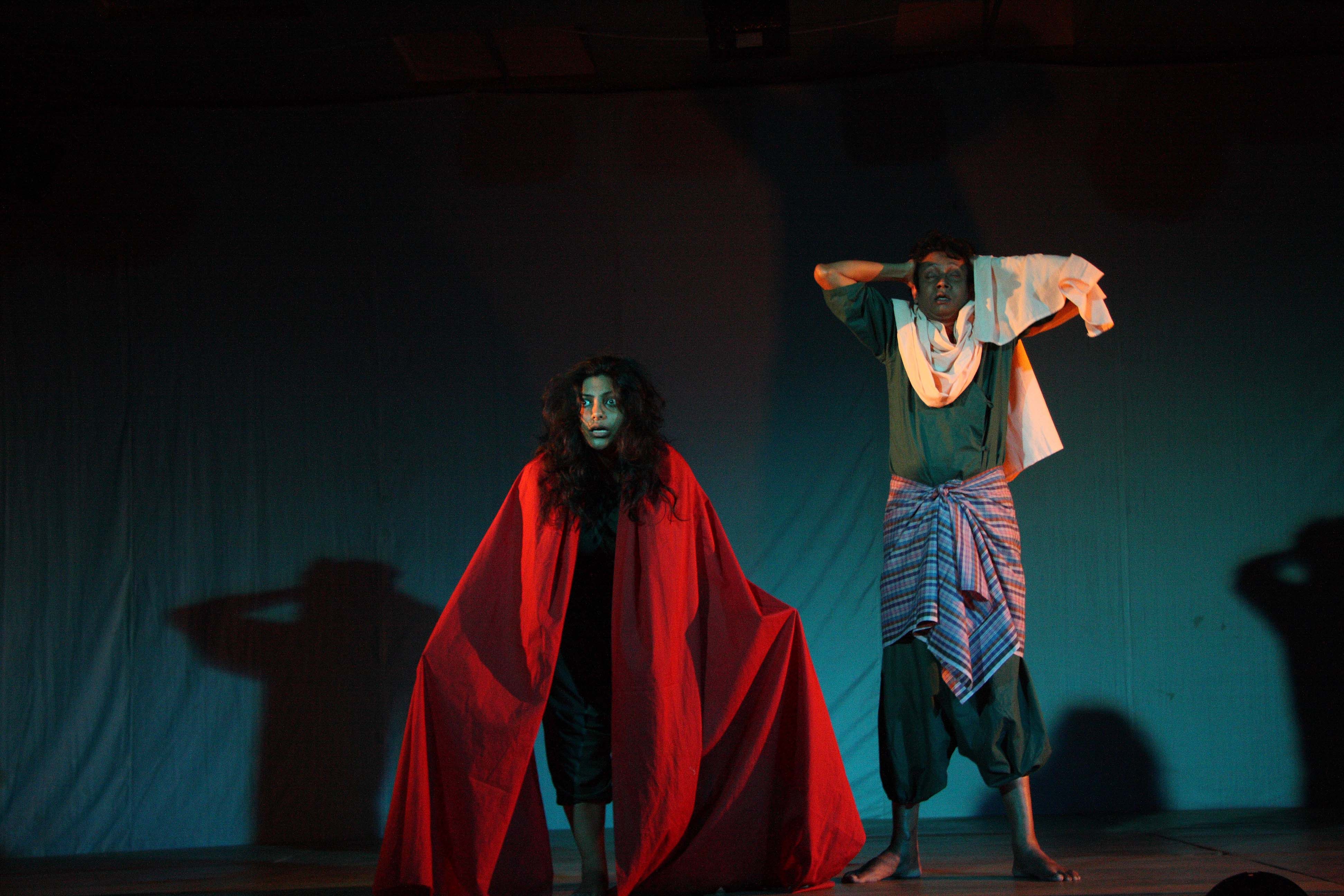
Dhamail
Opening show: May 2009
Playwright: Chandan Paul
Director: Mohammad Rafi Sumon
Storyline:
On August 27, 2009, Bottala celebrated its first anniversary with the premiere of Dhamail. Since then, the production has traveled far beyond Dhaka, with fifteen performances across the country—each echoing a profound longing for continuity, memory, and belonging.
The narrative of Dhamail unfolds within two intersecting realities. On one side lies the desperate struggle to preserve four centuries of rural tradition—the rhythms of song and dance, and the fragile yet enduring fabric of faith and community. On the other stands the relentless fight of farmers building embankments to resist the destructive erosion of the Padma River.
As the village stands divided, time rushes toward an unavoidable conflict. Between these opposing tides drifts a mystical boat, gliding upon the parallel currents of destiny. A bright full moon shines in the sky, its light softening the darkness. All around, the night is filled with the sound of crickets and the occasional cry of a jackal. Through that quiet night, a group of singers sails toward the village of Dhamail. The boatman’s oar cuts through the water like a verse through silence. As the vessel drifts, visions of Dhamail’s myths and landscapes gather like mist around the prow. The river swells with the tide, bearing stories distilled from human joy and sorrow—all bound by a single, yearning current.
It is a journey driven by an aching desire for freedom and a release from the self. This liberation remains both known and unknown, perhaps waiting in the familiar fairgrounds of Dhamail, or hidden within the tight embrace of the Padma’s embankment. There, in the sound of the wind, one hears a call—a call to truth and a simple life, where the spiritual and the everyday world meet, and the human spirit feels whole again.
Playwright’s Note:
Driven by the thought — “How can one approach the throne where my merciful Lord resides, with even a speck of sin in the heart?” — I immersed myself in the act of writing this play. It was merely an attempt to bring before the audience a way of life that has endured for four hundred years — to let that rhythm, that heritage, breathe once more upon the stage. The culture and traditions once inseparable from rural life have now, for the most part, faded into the past — remaining only as memories. Caught between rigid religiosity on one side and the pressures of modernity on the other, we, too, have begun to forget our own heritage, our past, and the eternal essence of our self — our “I.” This play, Dhamail, is born of a sense of responsibility — a longing to remind us once again of that forgotten “I,” to awaken in us the memory of who we truly are.
Director’s Note:
In the sweeping gusts of twenty-first-century globalization, we are all drEfteng, untethered. In the name of modernity, we are becoming increasingly disconnected from our roots.
All around us, conflict and strife rage in the name of religion. Fundamentalism is eroding our heritage, our culture, and even our most basic human relationships. Yet, a nation and its people are truly defined by their unique history and traditions—elements that are only strengthened through religious harmony.
We are heirs to a rich tradition and a diverse cultural tapestry. We must return to that heritage, moving forward into the future while carrying our traditions with us. It is this very impulse that led to the creation of this experimental folk production, Dhamail. Drawing on the four-hundred-year-old, multi-faith cultural traditions of Shimulia village in Bikrampur, this play celebrates humanity itself—its enduring spirit, its shared compassion, and its timeless music.