
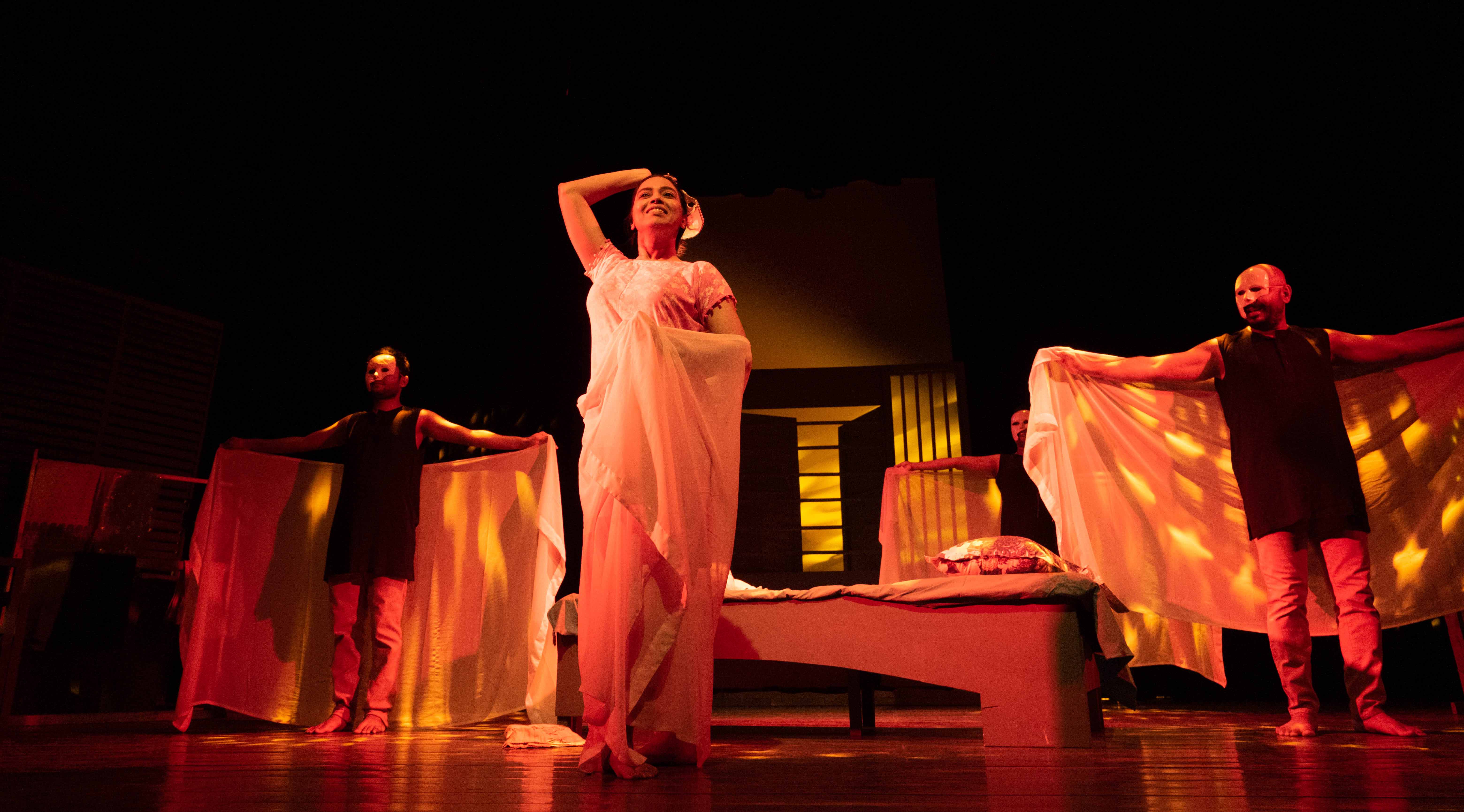
Rise and Shine
Playwrights: Dario Fo & Franca Rame
Adaptation: Abdus Selim
Direction: M. Saeed
Storyline:
Rise and Shine is a powerful story of a woman trapped in the relentless cycles of life and domestic confinement. She is no stranger—she lives among us, beside us, reflecting the struggles of countless women we see every day. This narrative resonates with the collective history of nearly every woman, every mother, and every working professional. On stage, you may see only a single actress, but through her, you will recognize the reflections of many. The play portrays the daily existence of the women we see in throngs every morning, crossing streets or climbing footbridges—women quietly enduring the endless, grinding routines of family life, working grueling overtime in garment factories for multinational corporations, and tolerating the temper of an inconsiderate husband. Ultimately, it is the story of finding the spark to break free and reclaim one’s life. Rise and Shine is a celebration of awakening—a defiant call to ask: “Why shouldn’t I rise?”
Translator’s Note:
Italian playwright Dario Fo and his wife Franca Rame jointly created a number of feminist one-woman plays. Their collaborative work was published in English as Female Parts: One Woman Plays by Pluto Press, London, in 1977. I translated the play Rise and Shine (alternatively titled Waking Up) into Bengali from this English collection, originally translated by Alwen Wymark. The play focuses on a young woman working in a factory, whose life is trapped within multiple cages—initially her husband, followed sequentially by her child, her job, and even her impoverished home. From the moment she wakes in the morning to prepare for work, her actions and the events of the previous night bind her in a cycle of helplessness. The play thus presents a realistic portrait of a woman’s dependent and restricted life, resonating deeply with the experiences of working women in Bangladesh, especially those in the garment sector. Consequently, the process of adaptation felt natural, though adaptation is not usually my preferred medium. I did not give the play a Bengali title because I could not find a precise equivalent that captured the essence of the English name; thus, I retained Rise and Shine. While I localized the play to the Bangladeshi context, I remained strictly faithful to the original text. That said, for the stage production, the director has necessarily exercised some creative freedom with my full approval. The play reached BotTala about two years ago. Under the direction of Mohammad Kamaruzzaman Sayeed and featuring the solo performance of Kazi Roksana Ruma, BotTala is now bringing this play to the stage. I extend my sincere gratitude and thanks to the actress, the director, and all members of BotTala for bringing my translated version of Rise and Shine to life.
Director’s Note:
Women are exploited at every turn—through wage deprivation, labor servitude, and the betrayal of love—both in the workplace and within the home. In this current era of capital accumulation, humanity has been alienated from one another, regardless of gender. Capital thrives and expands by exploiting the labor of the worker, yet the isolated cries of an individual rarely dent the iron fortress of capitalism. Impact is only truly possible when workers forge collective resistance. Because such resistance is rare, owners frequently exploit legal loopholes to abscond with workers' wages—a pattern seen across all nations and eras. Rise and Shine captures a vivid fragment of this pervasive exploitation. The collaborative genius of Dario Fo and Franca Rame does more than depict the deprivation of the factory worker; it illustrates how systemic exploitation and deceit penetrate beyond factory walls, into the worker’s home and even their psyche. The playwrights have crafted a remarkable feminist performance that compels us to search, alongside the protagonist, for the key to escape this cage. Professor Abdus Selim has demonstrated masterful craftsmanship in localizing this narrative brilliantly within the Bangladeshi context. Since I first studied the works of Dario Fo and Franca Rame during my early theater years, I have harbored a deep desire to stage their plays. I am profoundly grateful to my team, BotTala, for giving a young director the opportunity to lead such a production. My heartfelt thanks go to the designers and crew—without their dedication, this play would have remained confined to the pages of a script. I must also acknowledge our Advising Director, Mohammad Ali Haider, whose insights have served as the ornaments of this production. Finally, I extend my gratitude to every member of the team; your enthusiasm and collaboration inspired me to bring this vision to life. Long live BotTala!
Onstage: Kazi Roksana Ruma & team
Backstage Performers:
Playwrights: Dario Fo & Franca Rame
Adaptation: Abdus Selim
Direction: M. Saeed
Advising Director, Lighting Design & Projection: Mohammad Ali Haider
Projection Assistant: Mir Mohammad Badal
Lighting Supply: Light Fair
Choreography: Samina Luthfa Nitra
Music Design: Lochon Palash
Sound Assistant: Ujjal Chandra Sarkar
Costume Design: Taufique Hasan Bhuiyan
Costume Production: Leeds Tailors
Make-up: Sheyuti Shahgufta
Stage Design: Imran Khan Munna
Props Production: Tanvir Tushar & Abu Sufian
Ticket Management: Abdul Kader & Mizanur Rahman
Graphic Design: Samanta Sharmin, Mahbub Masum, Evan Riaz, Shahnewaz Efte
Music projection & Production Management: Nazifa Tasnim Khanam Tisha
Overall Management: BotTala
Acknowledgments: Abed Monsur, Bangladesh Mahila Samiti, Lalmatia Housing Society School and College