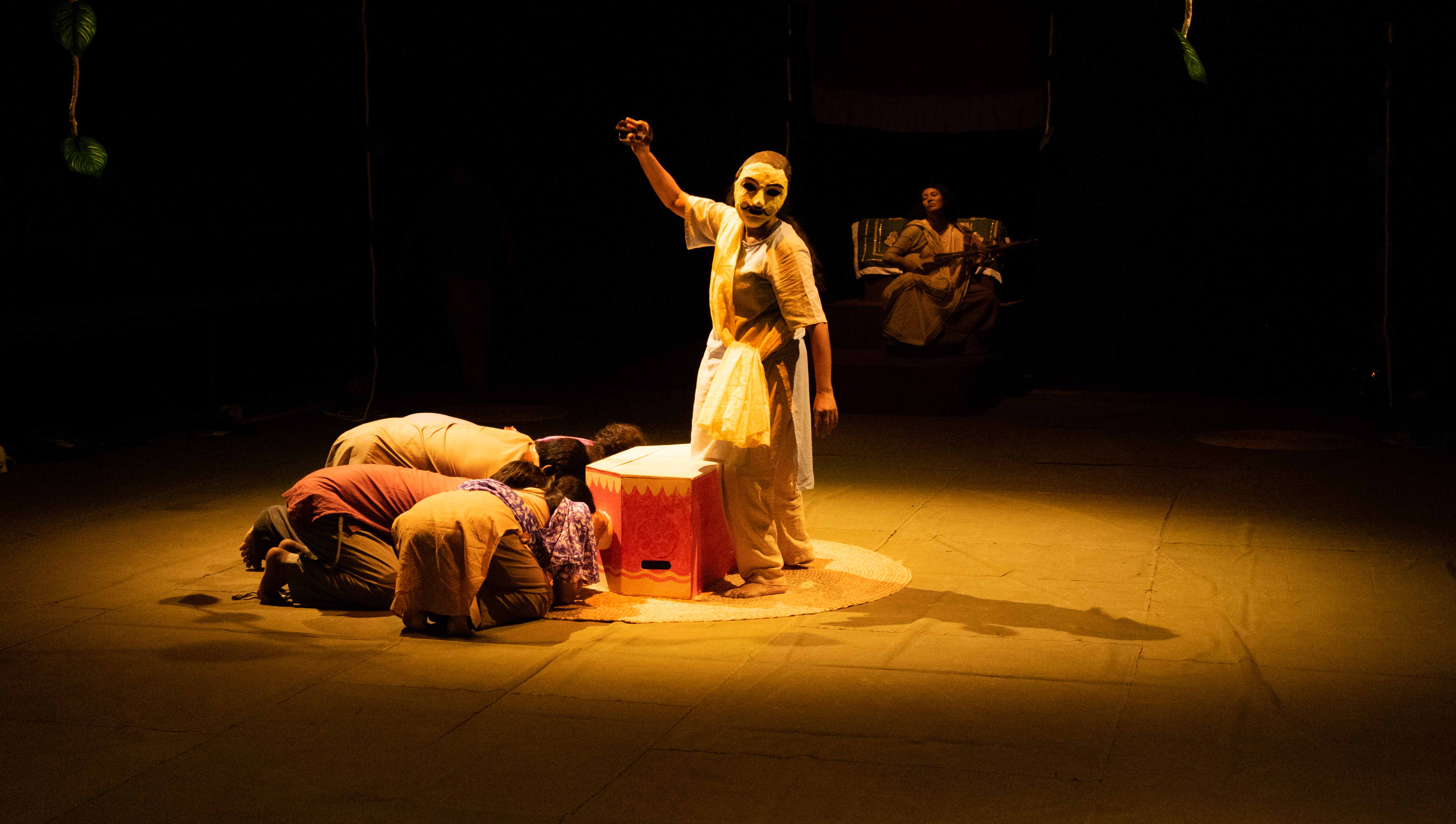
Jojongondha Maya
About This Event
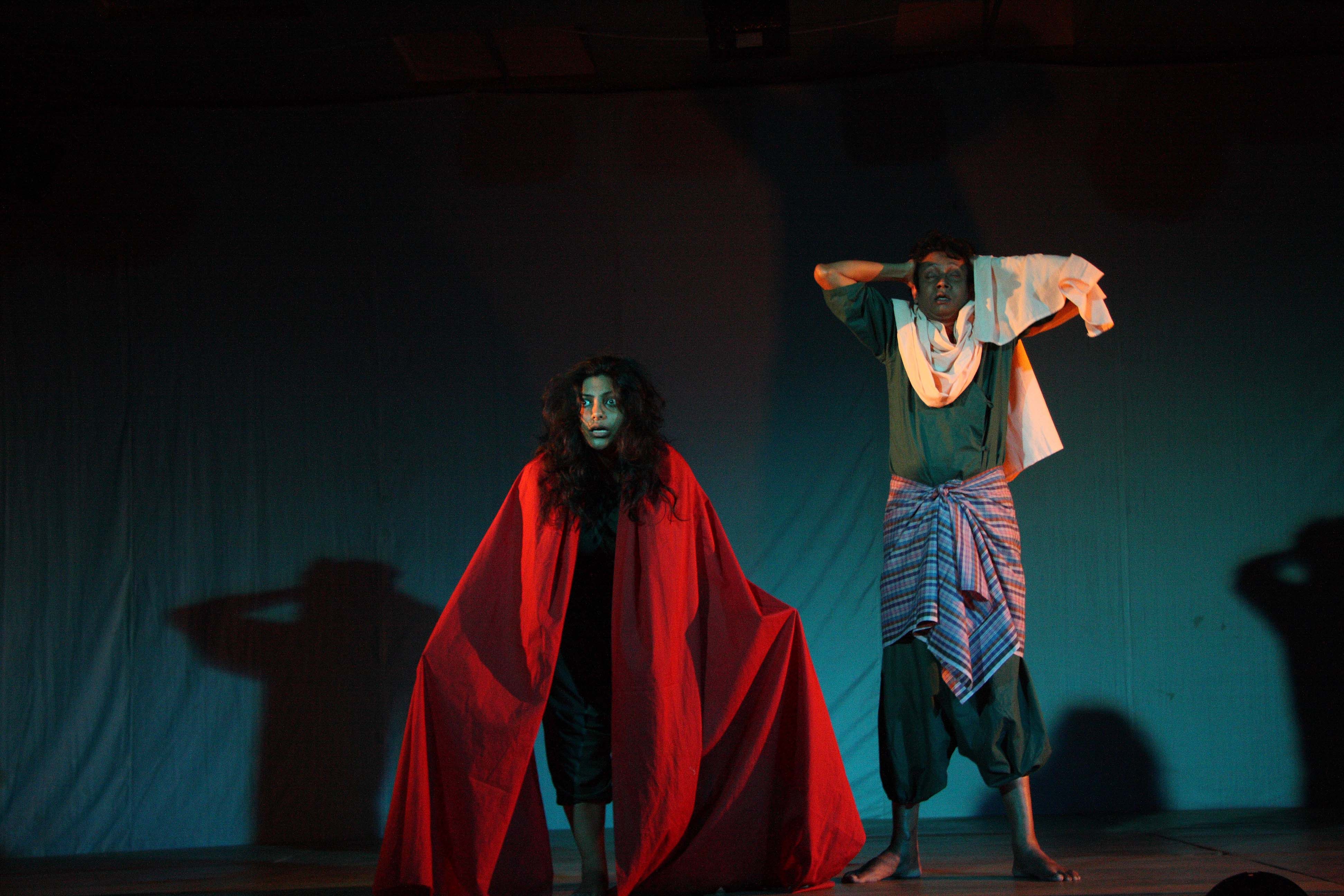
# Jojongondha Maya ## Synopsis The backdrop of *Jojongondha Maya* is Latiputi, a village much like any other village in Bangladesh. At the heart of the villagers’ lives stands the shrine of Kumir Pir. In this play, the spirituality of Kumir Pir is rooted in the earthly world. He speaks of the peasants’ right to food and teaches them to understand and claim their rights. For the crime of opening people’s eyes and teaching them to see beyond the blindfold, the Pir is killed. Yet in death, he gradually becomes an even greater source of courage for the people. The quiet revolution he leaves behind spreads through his disciples into the hearts of countless people. Kurumi continues another struggle around the shrine of Kumir Pir—a struggle to protect the rights of all living beings to the land. She becomes the bearer of the Pir’s message among the villagers. Like Kurumi, countless unnamed revolutionaries merge across generations into the faces of figures such as Ila Mitra and Pritilata, women who have fought from the front lines of history. Generations later, when Kurumi sends her son Johor to war in response to the demands of his time, Kurumi remains alive to this day—her face clouded by cataracts, her body worn down by age, waiting endlessly. The aged and frail Kurumi, and the waiting village community, begin to imagine Johor’s face in Alfred Pahan, who suddenly arrives one morning on the bank of Pir’s Beel and throws the entire village into turmoil. Pahan comes to the village as a symbol of Johor and the longing for rights and freedom. Everyone wants to hold on to him—Kurumi, Kajolbanu, Dainsha Mia. But Pahan, Johor, and the buffaloes never return from their struggle. Kurumi carries within her the aching thirst to see her lost son just once more. Human life has an end, but waiting has no end. Just as Kurumi waits for Johor, the people of this land wait for liberation. Yet true freedom remains elusive. At the end of every struggle, a community sings a hopeful song carrying a new dream—but in reality, that dream remains beyond reach. The events of the play move effortlessly between the Liberation War, the 2000s, and a time 120 years before that, engaging in conversations across generations. The play belongs to no particular period; it is a story of all time. The eternal struggle between the tiger and the buffalo, and the hope for change that has remained alive in the human heart for thousands of years—*Jojongondha Maya* is the tragic theatrical embodiment of that timeless struggle. --- ## The Playwright’s Note *Jojongondha Maya* was written several years ago, in a state of trance, almost as if I were wandering inside a dream. There was, perhaps, a warmth of distance within the writing. Perhaps that is why its name came to be *Jojongondha Maya*—a longing born of distance. From various turning points in our history, there have been repeated attempts to freeze or immobilize our 1971. But in reality, that has never been possible. The reason is simple: *You may bind the hands, you may bind the feet— but how will you bind the mind?* Whatever anyone may say, our 1971 is like the breath with which God breathed life into Adam. Even amid storms, rain and lightning, it moves, it turns, it refuses to remain still. Its resistance is immortal. Waiting is a kind of honey—one that no poet speaks of, yet it remains sacred. I have a few unscientific measures of my own, made in my personal workshop. For instance, how do you measure how civilized a community is? It is simple. You can understand how civilized a people are by observing how they treat their dead, and how much respect they show to those who have passed away. And how do we know whether a community or a nation stands upon solid ground? We can understand it by observing the density of their waiting. I have always felt—and still do—that our entire Bengal stands upon a blood-soaked fate. I do not know whether another nation exists that is as courageous, as humble, and as deeply wounded by sorrow as the people of Bengal. Bengal is full of scars and hollows. In Bengal, the bees do not hum in the melody of *Gunkoli*; instead, they borrow the cries of mothers and carry them through the air as sobs. Anyone who walks along the spine of Bengal will encounter this folk legend, which also flows through the heart of this play: Whenever there is a struggle, politicians place weapons in the hands of the fighters, while the wealthy provide food and supplies. But those who crawl along the bottom—the marginalized people—send their children to war. When the war ends, politicians shake hands with their political opponents. The wealthy raise the price of food in the marketplace so that their subsidies can be recovered. And the poor keep searching for the graves of their children who disappeared in the war. Such is the story of a search—a story of waiting, and of iron falling through cracks in the clouds. That is *Jojongondha Maya*. The metaphor I carried within my heart has been effortlessly defeated by the devotion and dedication of BotTala, by their countless sacrifices, wisdom and creativity. BotTala, may you continue to triumph. The boundaries of waiting that I had imagined for the marginalized people in this narrative have, in reality, been crossed and expanded far beyond my imagination by them. Before their collective strength, precision and vitality, I have once again accepted defeat. At this moment, I can only turn toward the blood-written classics—for I have been blessed with the fortune of being defeated by those whom I love. I establish my waiting in their honor— waiting for the one I left behind, waiting with a forward-looking hope, waiting for the settlement, the people, the homecoming. **— Badruzzaman Alamgir** *November 2025* --- ## The Director’s Note One evening in September 2023, I discovered *Jojongondha Maya* through my senior colleague, Samina Lutfa Nitra. The story felt like a fictional tale that had been unfolding for a hundred years—a story containing the unspoken narratives of countless people and the scent of days we have left behind. A story carrying within it the spark of revolution. Once, I staged a short story by Zahir Raihan titled *Somoyer Proyojone*. In that story, the commander asks, “Why are we fighting this war?” The answer comes: **“We are fighting because the time demands it.”** Our country is a land of tides and currents, of ebb and flow. Every community here has its own story—a scent of loss, a scent of things never attained. That scent continues to search through the silence of night, following the call of the *koral* bird breaking through the darkness. Long ago, the children of the sun who dreamed of freedom embarked upon struggles—from the anti-colonial revolution to the Liberation War of 1971. From Surya Sen and Pritilata to Ila Mitra, Bhashani and Bangabandhu, independence has travelled a long and difficult road. Yet at the end of every struggle, a community sings a hopeful song with a new dream—and ultimately, that dream remains unfulfilled. There is a strange color of sorrow in this play. Just as a mother waits for her child, a community waits for freedom. But does that freedom ever truly arrive? From Palestine to Bengal, where has the chapter written for freedom ever found its complete ending? I was drawn to the story of a mother waiting for her lost child. The scent of this story reminds me of the childhood I left behind—a scent I can still gather from many thousands of miles away. That scent, that illusion, compelled me to stage this play. Many works of art exist beyond questions. *Jojongondha Maya* is one such work for me. Art is created differently by different people. I have simply tried to create it in my own way. I wanted to tell this story through a hybrid theatrical form. The play carries within it the philosophical traditions of pirs, fakirs, ascetics and *auliyas*. Therefore, in its presentation, I have tried to combine indigenous forms with elements of Central Asian theatrical traditions. Throughout the story, I kept searching for the time that continually returns. I repeatedly entered the realm of the supernatural, without attempting to explain it—and I still do not intend to. The audience will create their own narrative. My deepest gratitude goes to playwright Badruzzaman Alamgir—for enduring all my persistent requests and frustrations and ultimately reshaping the manuscript into a form relevant to our time. I am grateful to Samina Lutfa Nitra, who has watched over my theatre practice from its earliest, hesitant steps and encouraged me to undertake the production of such a story. Special thanks to Tamjit Roy, who, despite living far away in Jalpaiguri, continuously supported the production with his advice and attention to countless details. I am grateful to Mohammad Ali Haider, who has always stood beside me, offering advice and helping me bring this production to the stage. And my deepest gratitude goes to every person who worked, over a long period of time, across the many branches of the stage and backstage. Without you, this play would never have seen the light. Finally, my heartfelt gratitude to my beloved theatre group, BotTala, for giving me the opportunity to direct this play and for supporting the production in every possible way. **Victory to the struggle.** **— Imran Khan Munna** *November 2025* --- # On Stage **Kurumi, Jinn Latinur:** Samina Lutfa Nitra **Kajolbanu, Monihar, One-and-a-Half-Foot Sirajuddoula & Villagers:** Kazi Roksana Ruma **Pahan, Villager:** Mohammad Ali Haider **Dainsha Mia, Villager:** Toufiq Hasan Bhuiyan **Kumir Pir, Villager:** Palash Nath Lochon **Johor, Priest, Falu & Villagers:** Mahbub Masum **Lakshmirani:** Samina Lutfa Nitra / Sharmin Iti **Monihar, Villager:** Mune Islam **Dukul Begum, Monjila & Villagers:** Monira Khatun Srishti **Haradhan, Hasan & Villagers:** Ashraful Islam Ashru **Villager:** Niranjan Das **Afai, Villager:** Shahadat Hossain / Ontu Chandra Nath --- # Music & Instruments Lochon Palash Layeka Bashir Shewti Shagufata Humayun Azam Rewaz Hamidul Hillol Nazifa Tasnim Khanom Tisha --- # Creative Team **Playwright:** Badruzzaman Alamgir **Direction & Stage Design:** Imran Khan Munna **Sound Design:** Palash Nath Lochon **Costume Design:** Mohsina Akter **Music Composition:** Palash Nath Lochon, Chondraboti Eva & Rishadur Rahman Rishad **Movement & Choreography:** Amit Chowdhury & Anondita Khan **Set Construction:** M. H. Sharif Anko **Props Construction:** Uttam Kumar Saha Chowdhury **Lighting Design:** Dhiman Chandra Barman **Poster/Cover Design:** Zafrul Hasan **Makeup:** Abdul Kader, Shewti Shagufata & Toufiq Hasan Bhuiyan **Language Coach:** Al Amin **Stage Automation:** S. M. Ismail Hossain **Digital Materials:** Mahbub Masum & Evan Riaz **Ticket Manager:** Abdul Kader **Production Coordinator:** Sumit Tewari Rana **Stage Manager:** Ashraful Islam Ashru **Overall Management:** BotTala