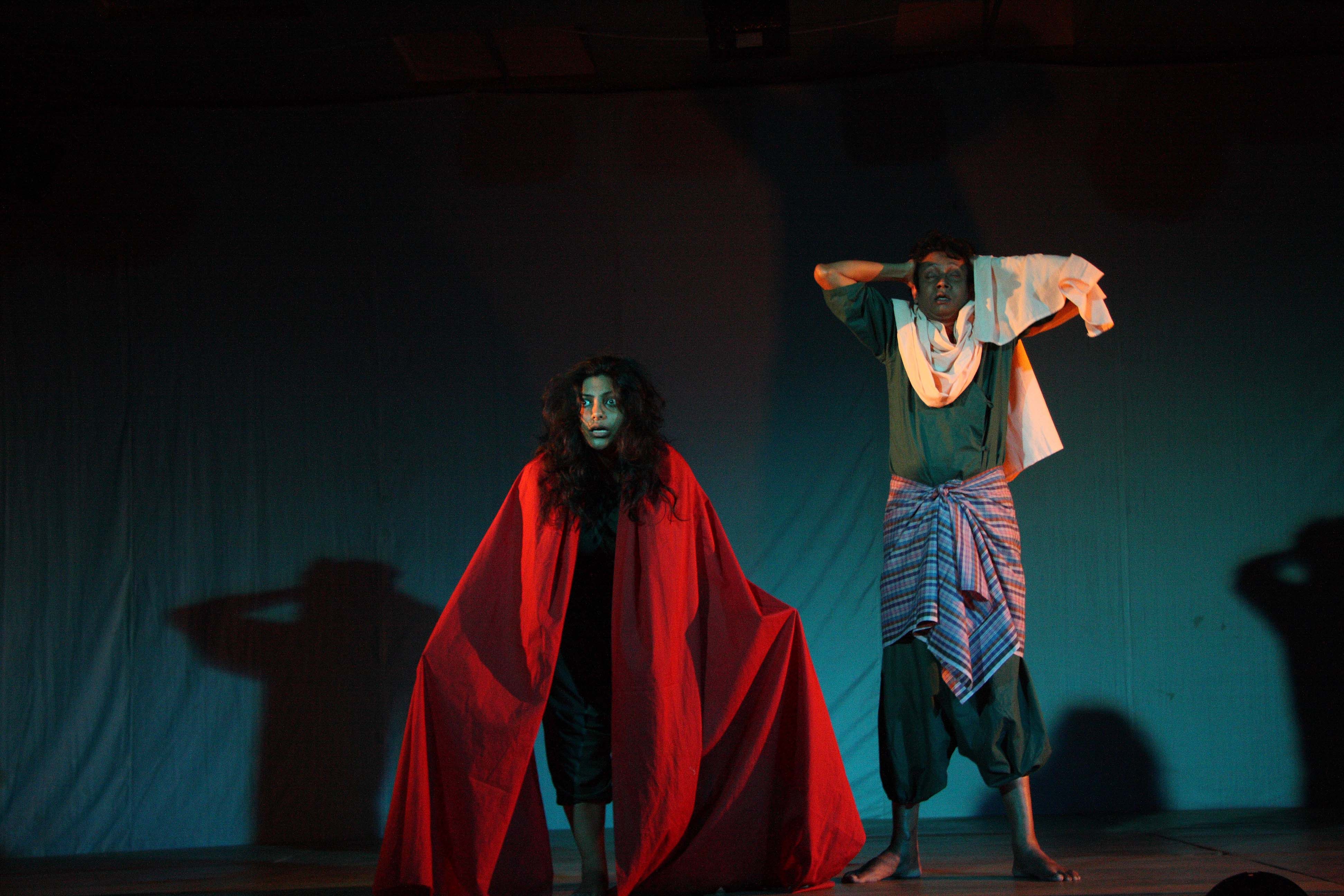

Marx in Soho
About This Event
## *BotTala & Jatrik Production* **Opening Show: 6 October 2021** ### Storyline: In Marx in Soho, Howard Zinn’s 1999 one-man play, the question posed by Marx resonates immediately: “Does it not surprise you that I must be declared dead over and over again?” Have you ever wanted to return to a conversation after it seemed to have ended? That is exactly what nineteenth-century philosopher Karl Marx desired in this sharp, insightful, and profoundly witty play. Inspired by Howard Zinn—the renowned American historian famous for A People’s History of the United States—the play imagines Marx, a century after his death, negotiating with the authorities of the afterlife to allow him a few hours back on Earth to restore his reputation. After being expelled from several European countries, Marx spent much of his life in Soho, London. Yet due to a minor clerical error in the celestial bureaucracy, he finds himself not in London, but in Soho, New York. There, reading contemporary American newspapers, Marx realizes that not only have people misunderstood his life’s work, but that the world has changed very little since his time. Marx in Soho offers an extraordinary portrait of Marx’s life while intertwining his social analysis and revolutionary aspirations. Howard Zinn demonstrates that Marx’s ideas remain highly relevant today, highlighting how issues such as income inequality, poverty, and unchecked nationalism—problems from Marx’s era—persist in the modern world. The play unfolds through small incidents and recollections, bringing to life the central figures of Marx’s world: his wife Jenny, his children, his critic and friend the anarchist Mikhail Bakunin, Friedrich Engels, and others. Jenny Marx emerges as one of the most compelling characters, revealing her pivotal role in his life. Despite limited financial or institutional support, the play has been produced across the globe because Zinn’s work directly challenges myths of American exceptionalism and the very foundations of democracy. Observing recent political developments, it is clear that true democracy is still elusive: a representative façade often conceals oligarchic or elite control. Marx in Soho is not just historically significant; its message echoes everywhere in the contemporary world. ### Translator’s Note: Karl Marx has returned to our time. It has been argued by some that a blind, hypocritical society is humanity’s only destiny—that we have reached the "end of history." We all suffer the consequences of this stagnation. Now, in this contemporary world, Marx returns with sharp, piercing satire. Howard Zinn’s Marx is not just a revolutionary or a uniquely brilliant mind in human history; he is also a poor, devoted, and loving father. He is immensely witty. In a society where the price of goods rises while the value of human beings diminishes, he grows rightfully indignant. Marx’s thoughts and struggles were born out of a deep, abiding love for humanity. His call to stand firm demonstrates why, in times of crisis, his voice is needed more than ever. This translation was undertaken to bring to Bengali-speaking readers Marx’s insistence on realizing the full potential of humanity. The translated text now takes its theatrical form—brought to life on the stage. May this play inspire Bengali audiences to think afresh about this world, to understand it more deeply, and to take decisive action to change it. ### Director’s Note: **About the Production** While studying in the United States, I was introduced to Howard Zinn’s seminal work, A People’s History of the United States. Immersed in a university setting alongside independent progressive thinkers, I found myself absorbing the ideas of Zinn, Noam Chomsky, Cornel West, Chris Hedges, Alan Watts, and Edward Said. It was during this period that I became acutely aware of the economic and psychological forces that shape the inhumane systems governing our lives. I realized that capitalism—long revered in America as a symbol of freedom—was, in reality, a system of enslavement responsible for the profound suffering of millions. Years later, while in COVID-19 lockdown in Dhaka, the opportunity to direct Marx in Soho brought a sense of immense excitement. In this play, Karl Marx directly challenges our current global systems, making it an incredibly timely story to tell. Zinn’s script allows Marx to defend the core of Marxism and communism, distancing his philosophy from the totalitarianism and dehumanized dictatorships of the former Soviet Union. I was deeply drawn to Zinn’s portrayal of Marx as a humanist. Consequently, this production addresses Marx’s philosophy from a humanistic standpoint rather than a purely political ideology. We see Marx as a human being with a keen awareness of the misery endured by the "have-nots." His world—19th-century Europe—was at the zenith of exploitation: of nature by industry, of the poor by the rich, and of women by men. It was an era defined by patriarchy, colonialism, and racism. Crucially, Zinn wrote this play to show Marx as few knew him: a family man struggling to support his wife and children. I chose to highlight his relationship with his wife, "Baroness" Jenny von Westphalen. Marx held a deep attachment and undying respect for her, depending on her both domestically and intellectually. She was his comrade in revolution and the true partner to his intellectual ideas. I wish to end with a sense of abiding hope, eloquently captured by Howard Zinn himself: “To be hopeful in bad times is not just foolishly romantic. It is based on the fact that human history is a history not only of cruelty, but also of compassion, sacrifice, courage, kindness... The future is an infinite succession of presents, and to live now as we think human beings should live, in defiance of all that is bad around us, is itself a marvelous victory.” **About the choreography** I studied two choreographers closely on YouTube, whom I had the opportunity to do workshops with, in Los Angeles. Both performed at Royce Hall, UCLA! Pina Baush once said, “You don’t repeat, you just do it again”. Stuck with me forever! As an actor this is very relevant when you have to do the same show many times. And Ohad Naharin who did an ‘open for all’ workshop on Gaga said, “Gaga is a movement language, not a technique”. This was, and is invaluable for dancers and actors. For this play, our process was a collaboration, I studied dance phrases and explained to my performer exactly how and what I wanted to express in each scene, using some phrases and some improvisation, and she reproduced whatever came out through her own body language. **About the music** I wanted to represent nineteenth century London, so I used three European composers from that period…Franz Liszt (22 October 1811 – 31 July 1886), Camille Saint-Saëns (9 October 1835 – 16 December 1921) and Claude Debussy (22 August 1862 – 25 March 1918). I used two modern composers for good reasons…Max Richter, who is a German-born British composer and pianist and works within post minimalism and blending contemporary classical and alternative popular musical styles. He is my segue between the past and present.… The other is music from Steampunk…a subgenre of science fiction that incorporates retro-futuristic technology and aesthetics, inspired by 19th-century industrial steam-powered machinery. This sub-culture explores not only alternative futures or pasts, but also addresses real-world social issues with artistic styles, clothing fashions, or other subcultures that have developed from the aesthetics of steampunk fiction, Victorian-era fiction, art nouveau design, films from the mid-20th century…and music, which "mixes Victorian elements and modern elements". Perfect for this play!!! The Christmas song “Joy to the World” was composed by George Frideric Handel in 1719…I presume it was popular during Marx’s time! Theme for Lizzie Burns is an English folk tune played with a 19th century instrument, Arpeggione. And the play after all, is set in New York. Therefore, I have bookended it with two jazz versions of 19th century classical compositions, Debussy’s Clair de Lune, and Franz Liszt’s Sonata in b minor. # Producers’ Note – ## Bottala: One of the world’s most influential philosophers, Karl Marx, whose ideas have shaped human society and politics from the nineteenth century to the present day, comes alive in the play Marx in Soho (or Soho-te Marx). While Marx is often recognized for his profound analysis in Capital, The Communist Manifesto, or The German Ideology, there is a different kind of fascination in discovering the everyday life of this extraordinary man—a life defined by "ordinary" domesticity, the struggles of poverty, and a deeply loving heart. In Marx in Soho, Howard Zinn portrays this globally influential thinker not through abstract theory alone, but through the lens of his daily joys and sorrows, painting the portrait of a genuinely humane visionary. Zinn’s true focus, however, is not merely Marx as an individual, but the enduring relevance and urgency of his ideas. Even 150 years later, the significance of Marx’s thoughts remains striking—and highlighting that contemporary resonance is Zinn’s central aim. For a marginalized theatre group in a country on the periphery of the global economy, conveying the contemporary relevance of such ideas is an irresistible challenge. In today’s pandemic-stricken world, where the profits of a few rise alongside the deepening plight of the many, staging Marx in Soho becomes an essential undertaking for BotTala. We turn to Zinn’s vision to help us understand and articulate the urgent necessity for systemic change. During the production process, BotTala was joined by Jatrik. This collaboration ensures that Zinn’s depiction of the humane Marx, along with his explosive revolutionary ideas, reaches a broader audience—fulfilling BotTala’s aspiration to bring such vital, transformative theatre to life. ## Jatrik’s Note How can we enable a just and equitable society? How can the most vulnerable be given a fair chance in life? How can we harness economic growth for the better? What can we do to address the widening gap between the rich and poor? How can we respect our planet and bring about sustainable practices? How can we fight patriarchy, racism, and colonial and corporate interests to ensure an inclusive and fair future for the coming generations? How can all young people have the opportunity to fulfill their potential? These are some of the fundamental questions we are still grappling with many years after Marx, and they are all the more prescient as we face the climate crisis today. The relationship of Marx with his wife, Jenny—who was his love, comrade, and intellectual partner throughout everything—and his struggles as a family man were integral to who he was and his quest. This has been beautifully explored by Howard Zinn. We joined BotTala to bring this play to you at this moment as a reminder of what many of us have been deeply worried about and have reflected upon, yet have often been distracted from by the structures that hold us back from bringing about real change. This is our first physical play since the pandemic—an event that forced us to step back from "life as normal" and view the world through a different lens. We hope this very human look at Marx, and the act of revisiting these questions, will inspire us to connect to each other and continue working toward real, hard solutions. ## Onstage: Humayun Azam Rewaz & Umma Habiba ### Backstage: Direction: Naila Azad Playwright: Howard Zinn Translation: Javed Husain Music, Set, and Scene Design: Naila Azad Choreography: Naila Azad & Umma Habiba Light design: Naila Azad, Imran Khan Munna Music projection: Eva Afroze Khan Costume Design: Tahmina Sultana Mou Lighting Projection: Mir Mohammad Badal Visual Editing: Maruf Raihan & Mahbub Masum Assistant Stage Management & visual projection: Nazifa Tasnim Khanam Tisha Graphic Design: Imran Hossain, Mahbub Masum, Shahnewaz Efte Promotional Video: Mahbub Masum & Shahnewaz Efte Stage Management: Bappi Amin